Remote Patient Monitoring Just Got Shorter; New 2–15 Day RPM Codes Explained
Learn how to bill the new CPT code 99445 for 2–15 day remote patient monitoring in 2026. Protect your revenue and avoid compliance audits.
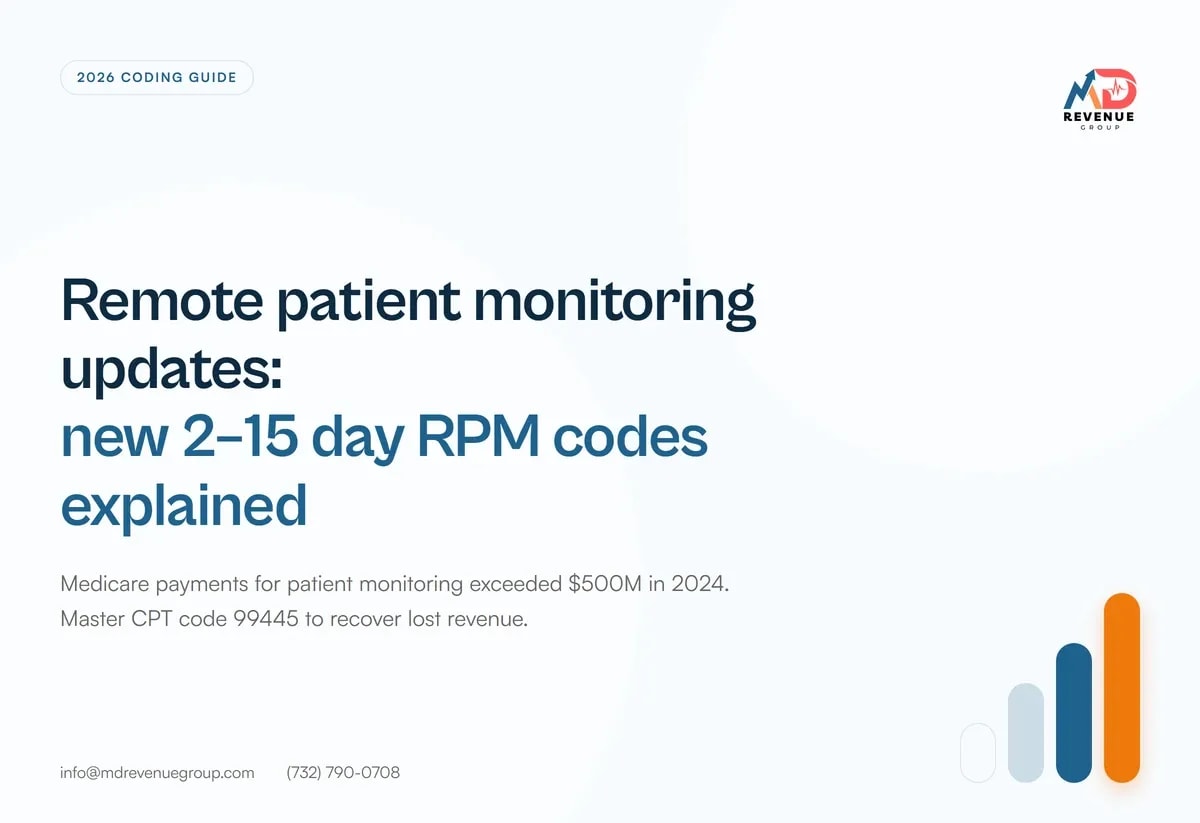
Practices utilizing remote patient monitoring (RPM) are gaining new billing options in 2026. The Centers for Medicare & Medicaid Services (CMS) is implementing codes that reimburse for shorter monitoring windows. Previously, practices had to hit a strict 16-day transmission minimum to receive any reimbursement for device supply. Under 2026 guidelines, you can bill for patient monitoring lasting between 2 and 15 days using CPT code 99445. This guide explains how to integrate these shorter monitoring codes into your practice compliance strategy.
Most industry updates repeat basic code descriptions. You already know that patients track their metrics at home. What you need is a practical billing workflow to capture revenue from patients who do not hit the 16-day threshold. The 2026 CPT code set has adjusted to clinical reality. If you bill these codes incorrectly, you will trigger an audit. If you bill them correctly, you will recover revenue that previously vanished.
This guide focuses on billing rules and clinical integration. It details the relationship between the new device supply code and the shorter treatment management code. It provides step-by-step documentation rules. It outlines the current federal audit priorities to keep your billing team prepared.
Key takeaways
- CPT code 99445 allows reimbursement for remote monitoring lasting 2 to 15 days within a 30-day period.
- CPT code 99470 is the companion code for shorter treatment management, covering 10 to 19 minutes of care coordination.
- You cannot bill short-duration codes and standard 16-day codes together for the same patient in the same month.
- CMS has confirmed that these new short-duration codes are fully covered for FQHCs and RHCs retroactively.
- The OIG is actively auditing RPM programs to find billing spikes and verify that a face-to-face visit initiated the service.
What Remote Patient Monitoring actually involves in 2026
You shipped the blood pressure cuff, you set up the portal. Your patient checked their pressure for 10 days, then forgot the device in a drawer. Under the old rules, you collected nothing for the hardware.
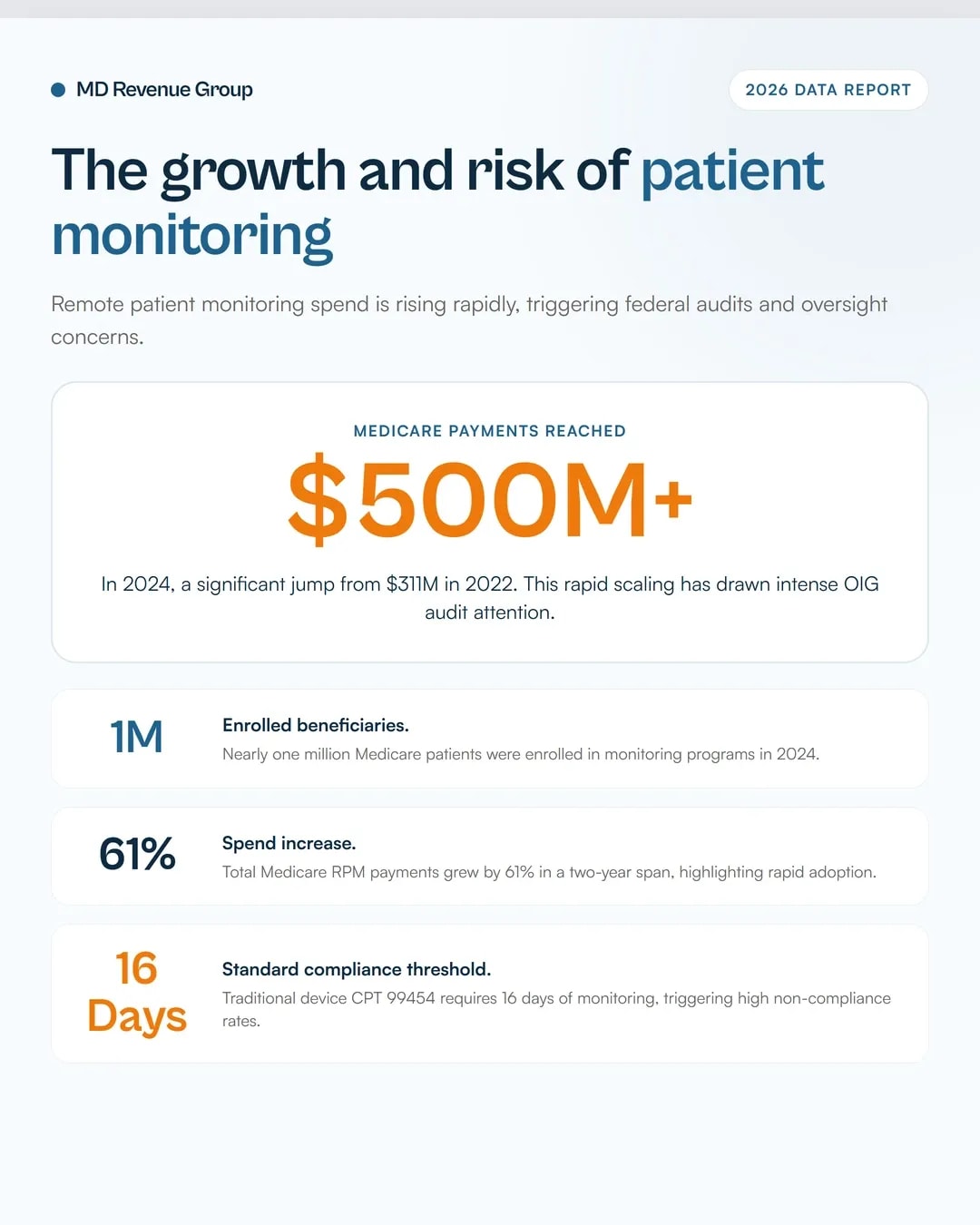
Traditional patient monitoring requires patients to transmit physiological data for at least 16 days out of a 30-day cycle to bill CPT 99454. In family practice and internal medicine, patient compliance is a constant struggle. Getting patients to transmit daily measurements is difficult.
The new 2026 framework establishes a secondary pathway. It allows you to bill for shorter monitoring cycles. If a clinical need only requires 5 days of monitoring, or if a patient stops tracking after 12 days, you can now receive reimbursement.
This model requires close tracking of data transmissions. You must record the exact days of data upload and the clinical purpose of the shorter window. If you lack this data, you will fail an audit.
Key CPT codes for remote patient monitoring
To bill remote patient monitoring in 2026, you must understand the two sets of codes. You have the standard 16-day codes and the new short-duration codes.
The device setup and supply codes cover the equipment and transmission:
CPT code | Monitoring duration | Focus of service |
|---|---|---|
99453 | One-time setup | Device setup and patient education on transmission workflows. |
99454 | 16–30 days | Device supply and daily transmission tracking per 30-day window. |
99445 | 2–15 days | Device supply and daily transmission tracking for shorter durations. |
The treatment management codes cover the clinical time spent reviewing the data and adjusting care plans:
CPT code | Required time | Focus of service |
|---|---|---|
99457 | 20+ minutes | Clinical staff time per calendar month. Requires one interactive contact. |
99458 | Additional 20 mins | Add-on code to 99457 for extra clinical management time. |
99470 | 10–19 minutes | Shorter clinical staff time per calendar month. Requires one interactive contact. |
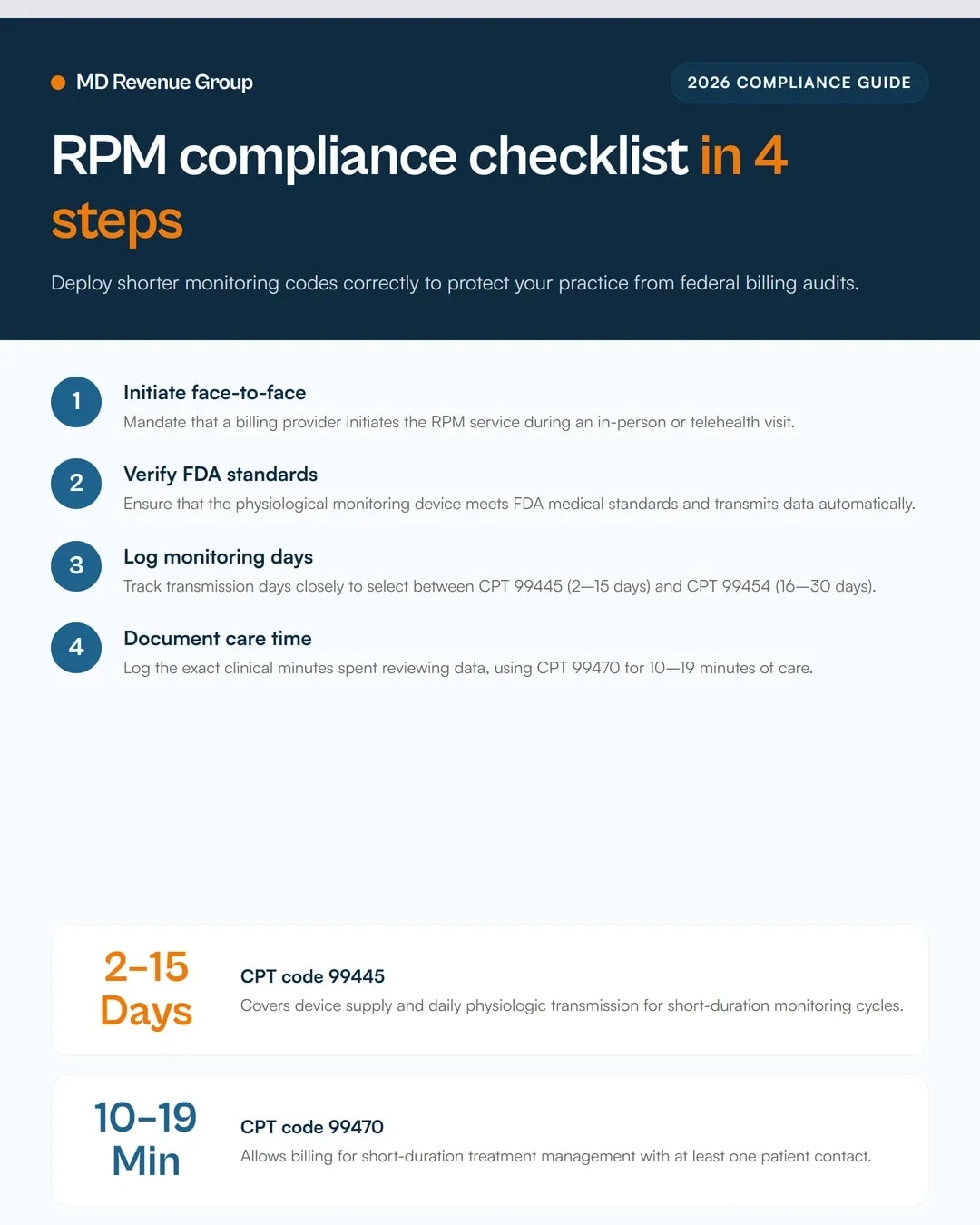
You must map these codes. If you bill the short-duration device code 99445, you will typically pair it with the shorter treatment management code 99470.
How to choose between standard and short-duration codes
You must determine which code to bill at the end of the 30-day tracking period. The codes are mutually exclusive.
If a patient transmits data for 17 days, bill CPT 99454. Do not bill 99445. If the patient only transmits data for 8 days, bill CPT 99445. You cannot stack these codes on the same claim for the same tracking period.
This decision requires your billing software to review the monthly transmission log. Your clinical staff must count the distinct days of uploads before they select the code. If your system defaults to the 16-day code without checking the logs, you will face claim denials.
You must also verify the clinical initiation. CMS requires that remote monitoring be initiated during a face-to-face visit for new patients. This visit can be in-person or via telehealth. You must document this initiation encounter in the medical record.
Federal audit priorities and OIG red flags
The rapid growth of patient monitoring has attracted federal scrutiny. The government is using data metrics to identify billing outliers.
An August 2025 data snapshot published by the Office of Inspector General (OIG) highlighted the scale of the program. The OIG reported that Medicare payments for patient monitoring grew to over $500 million in 2024 (up from $311 million in 2022). Nearly 1 million Medicare beneficiaries were enrolled in these programs in 2024.
This rapid growth led the OIG to list remote patient monitoring as a high-risk compliance area. The OIG is targeting specific red-flag behaviors:
- Practices billing for monitoring devices without documenting the required clinical review time.
- Sudden spikes in enrollment that exceed the clinical capacity of the practice staff.
- Billing for multiple monitoring devices for a single patient without documenting distinct medical necessity.
- A lack of a prior clinical relationship between the billing provider and the patient.
You must ensure your program is built on clinical outcomes. If you use remote monitoring as a passive revenue stream without active clinical contact, you will face clawbacks. Partnering with a compliance-focused telemedicine medical billing team ensures your documentation meets these federal standards.
How different payers cover short-duration remote patient monitoring
Payer coverage for the new 2026 codes varies. While Medicare has established clear guidelines, commercial insurers are adopting the codes at different rates.
Medicare Administrative Contractors (MACs) accept CPT 99445 and 99470. CMS also confirmed that CPT 99445 is a covered service for FQHCs and RHCs, effective retroactively to January 1, 2026. This allows community health centers to capture revenue for short-duration monitoring.
Commercial payers like Aetna and Cigna often require prior authorization for remote monitoring. They may limit the diagnoses that qualify for short-duration codes. They frequently reject claims that use generic chronic condition codes without specific clinical details.
You must test your payer mix. Bill a small sample of short-duration claims to each major commercial payer. Track the results for thirty days to see which insurers accept the codes and which require appeals.
This tracking keeps your billing clean. Working with a specialized internal medicine billing team allows you to build payer-specific rules in your scrubbing software. This prevents invalid claims from leaving your clinic.
The math of short-duration patient monitoring revenue
Let us look at the financial impact of the new short-duration codes.
Assume a clinic has 400 Medicare patients enrolled in a remote monitoring program. Historically, patient compliance limits billing.
In a typical month under the old rules:
- 300 patients hit the 16-day transmission mark (billed under CPT 99454 at 16,500
- 100 patients fail to hit the 16-day mark (generating 8 to 12 days of data): $0
- Total monthly device revenue: $16,500
In a typical month under the 2026 rules:
- 300 patients hit the 16-day mark (billed under CPT 99454 at 16,500
- 100 patients bill the short-duration code CPT 99445 (paid at approximately 3,200
- Total monthly device revenue: $19,700
By utilizing CPT 99445, the clinic captures an extra $3,200 monthly. That represents $38,400 in annual revenue that previously vanished. This revenue helps offset the cost of the devices and clinical monitoring staff.
To scale this program without increasing compliance risk, you must use structured tracking tools. You can run the numbers for your specific patient panel with our revenue cycle management workflows. You can also evaluate your billing health using our free audit program.
When to outsource remote patient monitoring billing to protect your revenue
Managing remote patient monitoring internally is difficult. Your staff must track daily data transmissions, document clinical review times, and count compliance days.
If your staff is overwhelmed, they will miss billing windows. They may bill the standard code for a patient who only has 12 days of data, creating an audit risk. Or they may fail to bill the short-duration code entirely, leaving money on the table.
Outsourcing to a professional billing team solves this problem. Dedicated RCM specialists verify your transmission logs before they submit any claims. They ensure you use the correct codes based on actual data.
This outsourcing strategy protects your clinic from audits. It keeps your clean claim rate high and ensures you receive the revenue you earned. If you want to evaluate outsourcing, you can check our pricing structures to see how we align with your volume.
Remote patient monitoring billing FAQs
What is CPT code 99445? It is a 2026 CPT code for remote patient monitoring. It covers device supply and daily transmission tracking for 2 to 15 days of monitoring.
Can I bill CPT 99445 and CPT 99454 together? No. They are mutually exclusive. You must choose one code based on the number of transmission days in the 30-day period.
What is CPT code 99470? It is the companion code for short-duration treatment management, covering 10 to 19 minutes of care coordination in a calendar month.
Do FQHCs and RHCs receive payment for CPT 99445? Yes. CMS confirmed coverage for FQHCs and RHCs retroactively to January 1, 2026.
What devices qualify for remote patient monitoring? The device must meet the FDA definition of a medical device. It must automatically collect and transmit physiological data.
Do I need a face-to-face visit to start remote monitoring? Yes. For new patients, the service must be initiated during a face-to-face encounter (in-person or via telehealth).
CTA: Recover lost revenue from non-compliant monitoring patients. We audit RCM workflows and find the revenue leaks. Request a free audit.