
How medical billing services in New Jersey fix denied claims
TL;DR
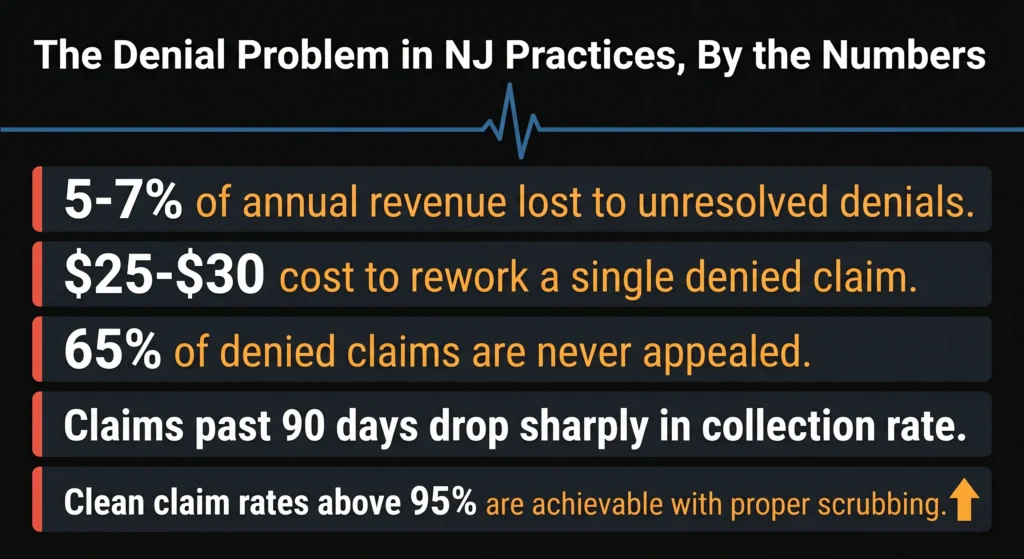
- NJ practices lose an average of 5-7% of annual revenue to unresolved claim denials — most of it is recoverable.
- Nearly 65% of denied claims are never appealed, meaning practices quietly absorb losses they don’t have to.
- The most common denial triggers are preventable: coding errors, missing documentation, eligibility failures, and late filing.
- Outsourced medical billing services in New Jersey can cut denial rates by catching errors before claims ever leave your office.
- MD Revenue Group works with NJ practices to reduce denials, recover outstanding AR, and keep revenue moving.
Somewhere in your practice right now, there’s money sitting in a pile that nobody’s collecting. It came back from a payer marked “denied.” And there’s a decent chance nobody’s going to chase it.
That’s the quiet financial leak most New Jersey medical practices don’t talk about — not because it’s minor, but because it feels complicated to fix. The truth is, it’s not.
The denial rate problem is bigger than you think
According to the American Medical Association, payers deny somewhere between 5% and 10% of all claims submitted. For a practice billing $1.5 million annually, that’s up to $150,000 in disputed revenue every year.
The worse number? The Medical Group Management Association (MGMA) reports that nearly 65% of denied claims are never reworked. Practices absorb the loss and move on. Staff are busy. Appeals take time. The billing queue keeps growing.
So the denial sits. Then it ages. Then it writes itself off.
Why claims get denied in New Jersey practices
Most denials aren’t mysterious. They come from a short list of predictable failures.
Coding errors are the biggest culprit. A wrong CPT code, a mismatched ICD-10 diagnosis, an unsupported procedure modifier — any of these can trigger an automatic rejection from the payer’s system before a human ever reviews it. For specialties like orthopedics, neurology, and pain management, where coding complexity is high, error rates climb even further.
Eligibility failures are a close second. A patient’s insurance lapses, they switch plans, or their coverage exclusions weren’t caught during check-in. The claim goes out, the payer rejects it, and your front desk has no idea until weeks later.
Missing or insufficient documentation causes a large share of medical necessity denials. Payers want to see that the procedure performed was justified by the diagnosis on record. When the chart doesn’t tell that story clearly, they say no.
Late filing gets less attention than it deserves. Every payer has a filing deadline, and they vary widely. Some commercial insurers allow 90 days. Others give you a year. Medicare has its own rules. A busy billing department tracking multiple payers manually will miss these deadlines. Once you’re past the deadline, the denial is almost always final.
The in-house billing trap for NJ practices
Small and mid-size practices in New Jersey often handle billing in-house because it feels like the safer, more controlled option. The billing staff knows the providers, knows the workflows, and sits down the hall.
The problem is that in-house billing teams are almost always understaffed for the actual volume of work. The average medical biller handles coding, claim submission, eligibility verification, payment posting, and denial follow-up simultaneously. When volume spikes — a busy week, a staff member out sick, a new EHR rollout — the backlog grows. Denials pile up. AR ages.
The cost isn’t just in the unpaid claims. A 2023 MGMA survey found that medical practices spend an average of $25 to $30 to rework a single denied claim. If your practice is working through hundreds of denials per year, the labor cost alone is substantial, even before you account for the revenue you’re still not collecting.
There’s also the knowledge gap. Medical billing regulations change constantly. CMS updates coding guidelines every year. Payer policies shift without much notice. Keeping an in-house team current on all of it is a full-time job that most small practices don’t budget for.
What a denial management process actually looks like
A proper denial management workflow doesn’t start after a claim is rejected. It starts before the claim goes out.
The first line of defense is claim scrubbing, an automated review that flags coding errors, missing fields, and eligibility mismatches before submission. Clean claim rates above 95% are achievable with the right process. When your clean claim rate goes up, your denial rate goes down. Simple math.
When denials do come in, they need to be categorized fast. Soft denials (missing information, requests for documentation) can be corrected and resubmitted quickly. Hard denials (coverage exclusions, medical necessity rejections, timely filing failures) require a different approach. Some can be appealed. Some require coordination with the provider to build the clinical case. Others need to be written off with a clear understanding of why.
The payer contract matters here too. New Jersey providers deal with a mix of commercial payers, Medicare, Medicaid, and multi-state managed care plans. Each has its own fee schedules, appeal windows, and documentation requirements. Knowing those details, and using them correctly during an appeal, is what separates recovered revenue from written-off losses.
Accounts receivable management and the 90-day cliff
Denied claims that don’t get resolved quickly become an AR aging problem. Industry benchmarks suggest that claims older than 90 days have a significantly lower collection rate than fresh claims. By 120 days, many are unrecoverable without significant effort.
Most in-house billing teams prioritize current claims because they’re easier to resolve. Old AR gets deprioritized. The result is an aging bucket full of partially worked denials and lapsed claims that represent real money your practice never collected.
Systematic AR management means working the entire aging bucket, including the tail end. It means having someone responsible for payer follow-up on a defined schedule, not just when there’s time. It means knowing which payers have the worst denial patterns so you can adapt your submission strategy for them.
Some of MD Revenue Group’s new client engagements start with a full AR cleanup, going back 6 to 12 months to recover revenue that had already been written off mentally, if not officially.
What outsourced medical billing services in NJ actually fix
Outsourcing medical billing to a New Jersey-based revenue cycle management company does a few specific things that in-house teams typically can’t.
First, it gives you a team whose entire job is billing. They’re not splitting attention between front desk tasks, EHR admin, and scheduling. Denial follow-up is their core function, not a task they get to when things slow down.
Second, a good billing partner tracks your denial patterns and tells you what’s driving them. If 30% of your denials are coming from a single payer for a single procedure code, that’s a fixable problem. The fix might be a documentation template change, a coding clarification with your providers, or a payer-specific submission adjustment. You can’t see those patterns unless someone is looking for them.
Third, outsourced billing teams stay current on coding updates and payer policy changes because that’s what they’re paid to do. When CMS updates the CPT code set each January, your billing partner has already adjusted. When a payer changes its prior authorization requirements mid-year, your team knows before the first claim goes out.
HIPAA compliance is another factor worth naming directly. A HIPAA-compliant medical billing service in New Jersey handles PHI under a signed Business Associate Agreement (BAA), maintains audit trails, and has security protocols that most small practices can’t replicate internally without significant IT investment.
What to do right now
If your practice hasn’t reviewed its denial rate in the last 90 days, that’s the first step. Pull a report from your practice management software or billing system and look at your denial percentage by payer, by procedure code, and by denial reason. Patterns will show up fast.
If you’re seeing denial rates above 5%, or if your AR over 90 days is growing, those are signs worth acting on. Practices in New Jersey that work with a dedicated medical billing company typically see denial rates drop to 3% or below within the first few billing cycles.
The revenue is there. You’ve already done the work to earn it. Collecting it is an operational problem with operational solutions.
If denied claims are cutting into your practice’s revenue, MD Revenue Group can help. Based in Jersey City, NJ, we work with physicians and practice managers across New Jersey and nationwide to cut denial rates, recover outstanding AR, and build a billing process that actually keeps up with your volume. Reach out for a free consultation and we’ll take an honest look at where your revenue is going.